Prompt de vídeo
Create a vertical 9:16 embroidered animation poster, viewed straight on as a closely photographed piece of real ivory fabric. Reproduce the supplied composition and the discrete running cycle with precision. The entire film is one stationary textile surface containing two small running hounds, one above and one below a fixed two line slogan. Use dark warm brown embroidery throughout. Deliver a silent 1080 by 1920 video. The visual cadence is exactly 10 distinct frames per second.
COMPOSITION AND MARGINS
Use one uninterrupted warm ivory cotton or fine linen surface filling every edge. No visible sheet edge, embroidery hoop, tabletop, frame or surrounding scene. Photograph it square to the camera, with no perspective tilt. Preserve the broad empty area above the artwork and below the lower animal. The overall arrangement is centered horizontally, but individual running poses naturally expand and contract around that axis.
Use these proportions as guides measured against the whole canvas. The upper running lane lies between approximately 22 and 40 percent of the canvas height. The two text lines occupy 44.4 to 55.4 percent of the height. The lower running lane occupies approximately 60 to 79 percent. Keep about 20 percent of the height visually empty beneath it. At maximum extension a hound and its small ground stitches can span approximately 78 percent of the canvas width; a gathered pose is narrower. Do not enlarge a compact pose to maintain a constant bounding box. Maintain the same animal scale and two fixed vertical lanes.
FABRIC AND EMBROIDERY
The base cloth is softly warm white with a faint cream or gray cast, clearly visible interwoven warp and weft, tiny natural fibers, shallow irregular creases and very slight uneven tension around dense stitching. Resolve the cloth weave across the whole frame. Avoid a coarse burlap grid. Light is broad, soft and steady, with no hard shadow or lighting change.
Use one nearly black, warm chocolate brown thread for animals, lettering, numerals and small ground marks. The animals are filled with dense short embroidery stitches, mostly following horizontal and gently diagonal directions across the body. Individual strands, occasional pale gaps and subtly raised thread edges remain visible. Thin legs and tails use smaller directional stitches. The outlines are imperfect and minutely serrated by thread, with tiny loose fibers. This is flat stitched artwork with physical thread relief, without realistic animal fur, sculptural bodies, glossy plastic or printed ink. Maintain the same thread weight and tonal treatment in the two animals and the text.
EXACT TYPOGRAPHY
Stitch precisely these two centered lines, preserving this spelling and line break:
NOTHING IS REAL
LET LOVE DESTROY YOU
Use tall, very heavy, condensed uppercase display serif lettering. The serifs are chunky and slightly wedge shaped, with irregular embroidered corners, uneven stem thickness and small imperfect counters. The visual character is rough antique wood type translated into dense thread. Do not substitute a clean modern sans serif, handwriting, a fine book serif or an ornamental blackletter font. Keep the two lines at essentially the same capital height. The first line spans approximately 61 percent of the canvas width, centered from x = 19.3 to 80.5 percent. The second spans approximately 82 percent, from x = 9.1 to 91.1 percent. Each line is approximately 5 percent of the canvas height. Leave approximately 1 percent of the height as clear cloth between the capital shapes of the two lines. Tight letter spacing, small but readable word spaces, straight horizontal baselines. Never stretch the first line to equal the second line's width.
The text is a persistent stitched element. Its wording, line breaks, relative alignment, letter shapes and size stay fixed through the entire animation. It never types on, pulses, waves, melts or changes into other letters. At most allow the tiny registration variation of photographed textile frames, shared with the cloth, rather than independent text motion.
ANIMAL DESIGN
Both motifs depict the same slender running hound in strict side profile, always facing right. Give it a long low body, a pointed muzzle, small triangular ears, a lean belly, long fine legs and a slender curved tail trailing to the left. Keep the muzzle, back contour and limb proportions recognizable through every pose. The body is a dark stitched silhouette, not a fully shaded anatomical rendering. Do not turn either animal toward the camera. Keep every paw, muzzle and tail inside the canvas at all times.
Place a few short, uneven dark stitched ground dashes beneath the feet. Their lengths and spacing change modestly between pose frames, as in a small antique locomotion study. They do not become a continuous track, a painted shadow, a horizon, dust or speed lines.
ELEVEN POSE RUNNING CYCLE
Build a repeating cycle of exactly 11 discrete poses. Hold each for 0.10 seconds. The hounds gallop in place within their respective lanes; their bodies do not travel across the page. Replace one embroidered pose with the next in a crisp stop motion step. Do not blend between silhouettes or generate smooth optical flow. Preserve slight physical stitch and cloth registration differences so the result feels made from separate photographed embroidery states.
Use this ordered action progression for the upper hound:
I: Body low and elongated. One foreleg supports beneath the chest, the other reaches forward; the rear legs trail back.
II: The rear legs begin folding forward under the body while the supporting foreleg sweeps back.
III: The hindquarters gather; one foreleg extends diagonally back and the other descends toward contact. The spine begins to round.
IV: The body rises and contracts. The legs fold inward beneath the torso and the muzzle points slightly upward.
V: Maximum gathered suspension, with an arched back and the paws grouped tightly beneath the belly.
VI: Begin opening out of the gathered pose. The forelegs remain bent while the hound prepares to reach forward.
VII: The leading foreleg unfolds and reaches downward; the rear legs remain gathered as the torso starts to lengthen.
VIII: The forelegs reach forward and down while the rear legs open backward. The body lengthens further.
IX: A long, low transitional stride with the rear legs extending behind and the forequarters reaching ahead.
X: Near maximum extension, a low elongated torso with forelegs reaching right and rear legs stretched left.
XI: Extended airborne suspension before the next forefoot contact. Return directly to pose I to close the gallop.
The lower hound uses the same 11 pose sequence, advanced by exactly two pose frames, a 0.20 second phase offset. When the upper hound shows I, the lower shows III. When the upper shows II, the lower shows IV. When the upper shows XI, the lower shows II. They remain separated by the static text block and never move in perfect synchronization.
ROMAN FRAME MARKER
At approximately x = 9.5 percent and y = 18.3 percent, above and to the left of the upper animal, embroider one very small serif Roman numeral with a period. It follows the current upper pose: I., II., III., IV., V., VI., VII., VIII., IX., X., XI., then repeats. Its height is approximately 2 percent of the canvas height. Keep its anchor fixed; only the numeral changes. No other titles, captions or counters.
CAMERA, TIMING AND LOOP
The camera is completely locked: no pan, tilt, zoom, handheld shake, refocus or perspective shift. Keep the fabric texture and lighting stable. Allow only extremely small frame registration irregularities intrinsic to the textile sequence. Do not show a needle, a hand, sewing, stitches being drawn or a dog gradually materializing. Every state is already embroidered.
One complete cycle lasts exactly 1.10 seconds. Repeat the 11 frame cycle 15 times for a 16.50 second film, 165 frames at 10 fps. Start with upper pose I and lower pose III. Keep every hold equal. The last pose must step naturally into the first pose when the film repeats. No fade, introduction, closing card, added pause, reverse playback or duplicate held frame at the seam. No audio track.
NEGATIVE PROMPT
Smooth interpolated animation, morphing silhouettes, realistic moving dogs, animal fur, changing species, extra animals, missing legs, extra limbs, amputated paws, cropped tail, frontal face, body translation across the page, synchronized upper and lower poses, scrolling background, typing text, misspelled words, changing line breaks, stretched first line, thin font, modern sans serif, glossy thread, flat printed texture, digital vector edges, coarse burlap, shallow depth of field, bokeh, dramatic lighting, hard cast shadow, camera motion, sewing needle, visible hands, embroidery hoop, browser UI, borders, soundtrack, captions, fade or freeze at the loop seam.
Prompt details and source
Reconstruido a partir del vídeo de origen completo de 16.5 segundos y su ciclo de once poses. La composición y el espaciado tipográfico se midieron en los fotogramas originales. Es una especificación detallada, no un resultado de generación verificado.
Leer prompt de la imagen de portada
Create one vertical 9:16 embroidered poster photographed square to the surface of warm ivory cotton or fine linen. The cloth fills every edge, with clearly visible fine warp and weft, small natural fibers, slight uneven tension and shallow creases. Soft even light. All artwork uses very dark warm chocolate brown thread, with dense mostly horizontal and gently diagonal fill stitches, tiny pale gaps and uneven fibrous contours.
Arrange two slender running hounds in strict side profile facing right, separated by a centered two line slogan. Keep generous empty cloth above and below. The upper animal occupies roughly 22 to 40 percent of the canvas height. Show it in a gathered stride with rear legs curled forward under its body, one foreleg descending and the other extended diagonally back. Preserve its pointed muzzle, small triangular ears, slim legs, long body and thin curved tail. The lower animal sits around 60 to 79 percent of the height in a more compact airborne pose, its rounded back raised and paws grouped beneath the belly. Keep both animals at the same physical scale, without enlarging the compact pose. Add a few short uneven stitched ground dashes below each animal.
Between the animals stitch exactly these two centered lines:
NOTHING IS REAL
LET LOVE DESTROY YOU
Use very heavy condensed uppercase display serif lettering with chunky slightly wedge shaped serifs, irregular stitched edges and small imperfect counters. Keep both lines the same capital height, approximately 5 percent of the canvas height. The first line spans 61 percent of the width and the second spans 82 percent. Their combined block occupies approximately 44.4 to 55.4 percent of the canvas height, with a narrow clear cloth gap of about 1 percent of the height between the letters of the two lines. Preserve tight letter spacing, readable word spaces, straight baselines and exact horizontal centering. Do not stretch the shorter line to match the longer line.
Place a tiny stitched serif numeral “III.” at approximately x = 9.5 percent and y = 18.3 percent. Its height is about 2 percent of the canvas height. Retain around 20 percent empty cloth below the lower motif. The animal shapes are flat embroidery with subtle physical thread relief, not realistic fur or dimensional sculpted animals. No needle, hand, hoop, paper edge, frame, camera tilt, extra wording, interface, glossy plastic, smooth vector outline or modern sans serif lettering. This is one complete still frame; do not request motion or combine several animation frames into a contact sheet.
Leer texto de origen
Recent.design describes the animation as built from individually embroidered frames. No original generation prompt was provided.
Figura corriendo bordada en tela cálida color marfil, con fibras tejidas visibles y detalles de bordado. Obtén el prompt del vídeo y el primer fotograma para adaptarlos en Clico Web.
Referencia del primer fotograma
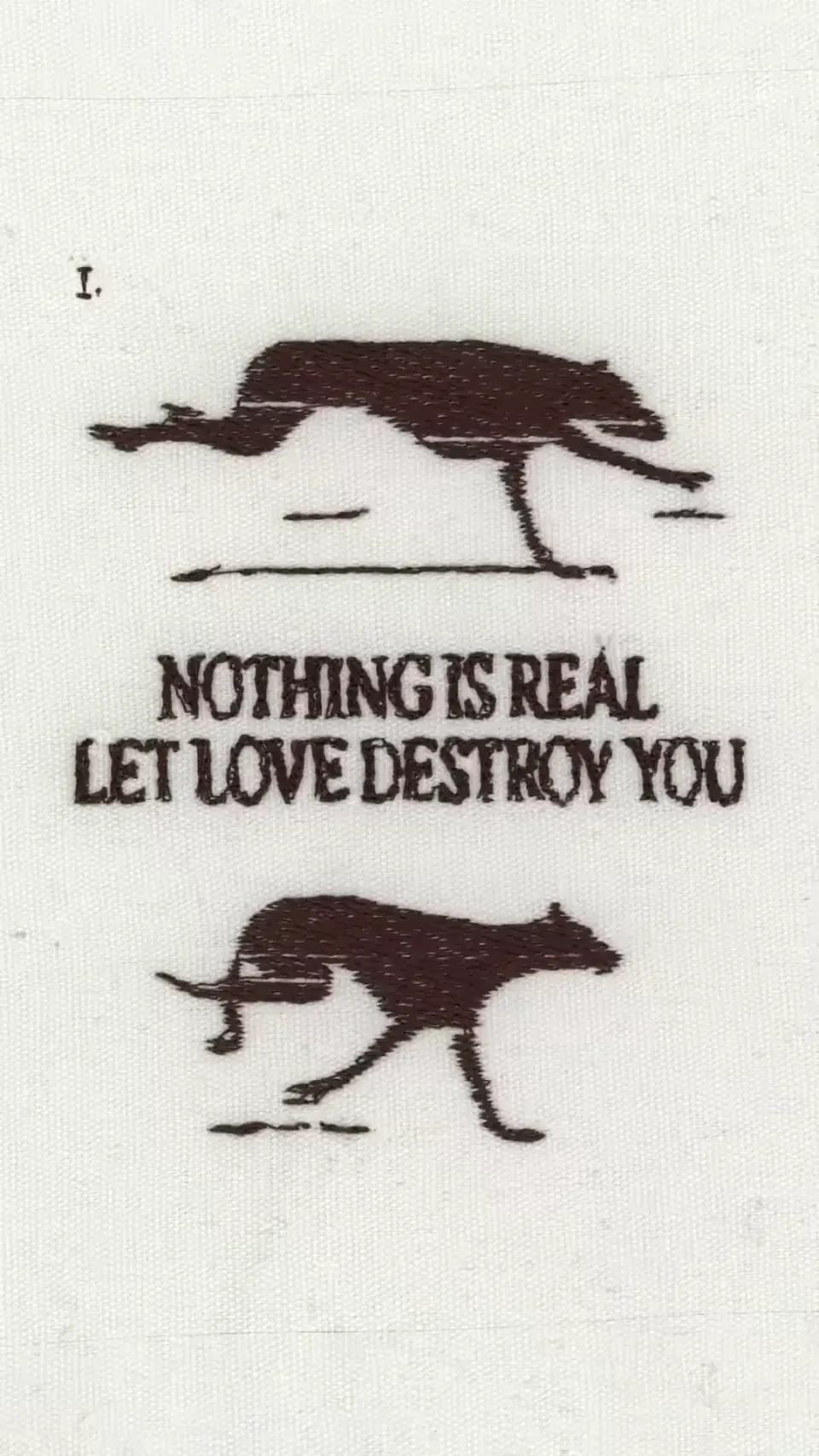 Descargar primer fotograma
Este fotograma se incluirá al continuar en Clico Web. Puedes reemplazarlo allí.
Cámara: Vista casi frontal del bordado, con ligeras variaciones de registro entre fotogramas. Dos animales bordados alternan poses de carrera sin cruzar el lienzo.