Prompt vidéo
Create a fast editorial print collage loop built from twelve distinct paper frames. The recurring subject is one cyan blue goat in side profile, always facing right and walking in place. Around it, printer calibration graphics, sampled type and real marker drawings change on every frame. Reproduce the specific sheet layouts and the rhythm described below. Deliver a 740 by 776 pixel near square silent clip, exactly one second long at 12 fps, with twelve equal frame holds. The image fills the canvas without a surrounding desk, browser or presentation mockup.
FIXED SUBJECT AND COMPOSITION
Keep one recognizable goat near the center throughout. Its silhouette spans approximately x = 16 to 81 percent and y = 28 to 79 percent of the canvas, depending slightly on leg position. Its long horizontal torso remains around mid height, with the head raised at the right. Give it thin horns curving backward to the left, small ears, a short beard under the pointed chin, a short upturned tail at the left, a broad simple body and four slender legs with small hooves. Use an opaque looking but printable cyan blue silhouette, without a visible eye, face shading, fur texture or dimensional modeling. The blue has fine paper and ink grain, not a smooth vector fill.
Animate a modest walking step through the twelve frames: forelegs and hind legs alternately lift, bend, extend and plant. Retain the same animal design, size, facing direction, head position and body placement. The legs change discretely while the body has only minor registration variation. No galloping, jumping, turning, travel across the page, large head bob or replacement with another animal. The recurring blue form must remain easy to follow even when test graphics print over it.
PRINT AND DRAWING TREATMENT
Use bright off white matte paper with fine photocopy speckle, subtly rough toner edges, soft ink spread, occasional tiny dust marks and slight color misregistration. Keep the surface front facing and evenly illuminated. Avoid glossy paper, physical perspective, cast shadows, paper curl or an outer page border.
The base graphics come from a functional printer test sheet: straight color ramps, swatch grids, CMYK letters, registration targets, concentric color rings, continuous color discs, fine line fans, halftone samples, geometric shape samples and typography tests. These retain their mechanical geometry despite the imperfect print texture. Many printed words are rotated 90 degrees clockwise as part of the sampled sheet. Preserve that sideways orientation and the deliberate cropping at the frame edges. The goat stays upright while the paper labels run vertically across the page. The camera never rotates.
Overprint overlapping graphics with believable transparent ink mixing. Blue goat areas beneath a purple bar become deeper violet blue; yellow and blue overlaps turn green; black ramps darken everything beneath them. Hand added marks have marker or pen texture: irregular wet edges, translucent overlaps, small gaps, pooled ends and varying stroke widths. Alternate thick fluorescent fills, short dashes, dots, hearts and fine looping scribbles. Do not turn these into clean digital icons or animate each stroke drawing itself. Each frame is an already completed paper collage.
Use ordinary bold printer sample sans serif lettering, with some large heavy uppercase headings and smaller regular samples. Keep text as printed type, not hand lettering. Readable labels below must retain their stated spelling. Source fragments may remain deliberately clipped by the canvas. Do not invent additional sentences to fill gaps. Match the source letterforms, weight, character widths, spacing and orientation consistently across all twelve states.
ORDERED TWELVE FRAME SEQUENCE
Every state below lasts exactly 1/12 second, approximately 0.08333 seconds. Hard cut directly to the next state. Keep the goat aligned while replacing the surrounding artwork. The timeline labels here are production instructions and must not appear on the image.
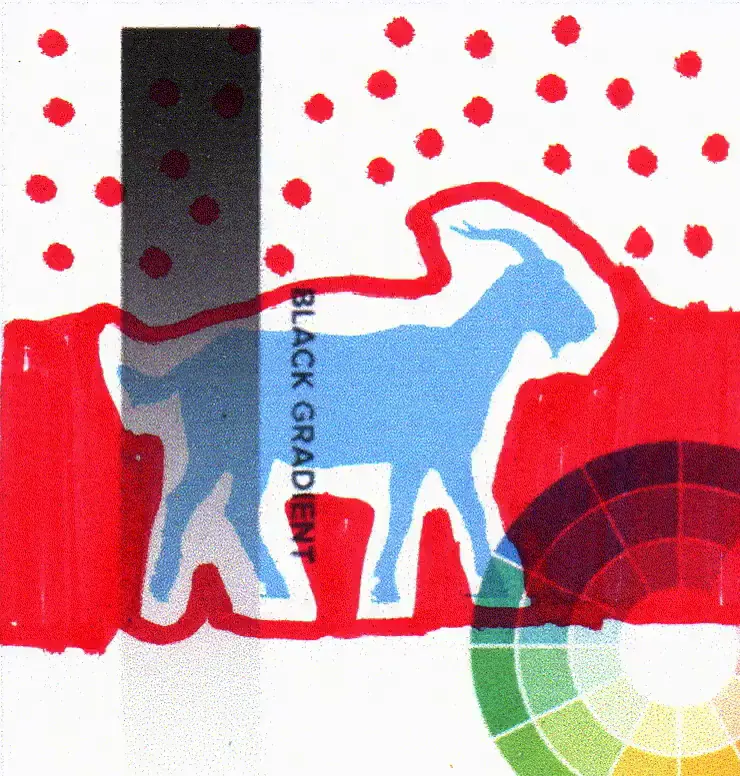
01, 0.000 to 0.083 seconds: Black gradient and red dots. Fill the central horizontal region, roughly 40 to 82 percent of the height, with a broad vivid red marker field. Leave an irregular white halo immediately around the blue goat. Scatter loose red dots across the upper white area. A tall black to pale gray gradient bar occupies x = 16 to 36 percent, starting near the top edge and extending down across the goat's rear body and hind legs. Overprint the sideways bold label BLACK GRADIENT around x = 40 percent, reading down through the torso. A segmented color wheel enters from the lower right, with concentric tint rings and a pale center; crop it at the right and bottom edges. Preserve transparent color mixing where the wheel overlaps the red field.
02, 0.083 to 0.167 seconds: Four gradient columns. Use a mostly white page with four tall parallel vertical color ramps occupying the right three fifths: purple, coral red, blue and green, in that order. Their upper ends are solid color and the lower ends fade into white. Overprint the aligned blue goat across these ramps. Set COLOR WHEELS sideways just left of the goat's body. A partial segmented wheel enters at the lower left. Surround the animal with widely spaced short burgundy marker dashes, arranged loosely like a radiating oval, rather than a geometric circular border.
03, 0.167 to 0.250 seconds: Golden yellow color gradients. Cover almost the whole sheet with broad translucent golden yellow and orange marker strokes, preserving a rough white cutout around the blue goat. Retain a narrow pink offset edge at the left side of that cutout. Across the upper left and middle place tall yellow, pink red, blue green and black gradient strips. Add four smaller stacked color swatches near the right edge. Print COLOR GRADIENTS sideways near x = 63 percent, descending from the top toward the goat's forehead. Add scattered small orange dots. The broad marker coverage stays streaky and handmade.
04, 0.250 to 0.333 seconds: Red hatching and green scribbles. Return to white paper with a cyan and magenta test band at the left, including the small C and M labels. Surround the goat with dense vertical red marker ticks. Use thicker red fills around the spaces beside and between its legs while preserving the white animal halo. Place loose lime green elliptical scribbles in the top right, bottom right and lower left. A registration target is partly cropped at the right edge. Preserve cropped sideways test sheet fragments at the left and bottom, including CMYK, without expanding them into new headings.
05, 0.333 to 0.417 seconds: Swatch grid and mint dashes. Place two columns of four wide rectangular swatches across the upper middle and right. Left column: dark green, cobalt blue, dark violet and nearly black. Right column: yellow, orange, red and bright green. Narrow white gutters separate the swatches. The goat overlaps the lower half of this grid with visible ink mixing. Cover the white areas with uneven mint turquoise vertical dashes and a few dots. Print 8. REGISTRATION / REGISTRO sideways along the left, and a small sideways IMAGE near the bottom, partly cropped if needed. Keep these labels mechanically printed.
06, 0.417 to 0.500 seconds: Solid color blocks and blue hearts. Use a bright white sheet with stacked cyan, blue, hot pink and pale pink blocks cropped at the left, and black and gray blocks beside them near the upper middle. Show the goat clearly through the center. Place a huge bold sideways PRINTER heading along the right edge, with the following text cropped beyond the canvas. Print the smaller SOLID COLOR BLOCKS down through the goat's front half. Add small loose blue pen hearts and sparse curved blue scribbles around the animal. The hearts are asymmetric outline doodles, with unfilled white interiors.
07, 0.500 to 0.583 seconds: Color disc and confetti. Keep a mostly white page densely scattered with small red, green and blue marker dots. A narrow vertical yellow ramp sits at the upper left; a black ramp continues below it behind the hind legs. A large continuous rainbow color disc enters from the right and overprints the goat's head and front body. Its outer right portion is cropped. The disc has a smooth printed hue field rather than the segmented rings of frame 01. Preserve faint sideways cropped printer labels along the left edge. The dots belong to the flat page and do not fall through space.
08, 0.583 to 0.667 seconds: Resolution fan and violet scribbles. On white paper place a rectangular fine gray noise sample and a fan of densely converging black lines behind the right half of the goat. The lines spread toward the bottom edge. A portion of a yellow to red color disc is cropped at the left. Add thin violet looping pen scribbles at upper left, upper right, lower left and lower right. Keep one tiny violet circular mark near the lower center and a partial sideways QUALITY fragment near the top. Do not blur the fine line geometry into a generic gray gradient.
09, 0.667 to 0.750 seconds: Orange test page. Fill nearly the whole background with overlapping vivid orange marker strokes, leaving a thick irregular white halo around the goat. A huge black sideways TEST PAGE heading runs down the right and is cropped at its upper edge. Set FINE LINES sideways across the front leg area. Dense straight horizontal and vertical black line test patches enter from the lower left and bottom, with a few diagonal white hatch gaps in the orange fill. Retain the contrast between rough marker edges and precise printed rules.
10, 0.750 to 0.833 seconds: Registration and alignment. Use a clean white base. Surround the goat with a thick translucent pink marker contour, following its silhouette at a loose distance. Place three registration targets down the left: circular crosshairs at top, middle and bottom, with cyan, magenta and yellow offset rings in the middle target. Print REGISTRATION & ALIGNMENT sideways through the central body. Place small halftone dot samples and diagonal line patches just right of center. Down the far right edge arrange oversized black geometric forms: square, circle, triangle, star and hexagon, partly cropped by the edge. Add a small wavy line test near the lower right.
11, 0.833 to 0.917 seconds: Shapes and large typography. Keep white paper. Along the left edge place a cyan square, magenta circle, yellow triangle, green star and blue hexagon. Print SHAPES & PATTERNS sideways beside that column. Across the blue goat, overlay large black sideways type samples reading 28 pt: The quick brown fox, followed by jumps over the lazy dog. Then 32 pt: The quick brown fox, followed by jumps over the lazy dog. Let the sample occupy most of the goat's body and extend toward the edges. Add thin tangled burgundy pen scribbles near the upper left and right. Preserve intentional printed overlaps instead of moving the words outside the subject for readability.
12, 0.917 to 1.000 seconds: Fluorescent text quality. Cover most of the sheet with translucent fluorescent yellow green marker, leaving a rough pale halo around the goat. Keep a vertical column of smaller green, dark blue, red, ochre and brown sample blocks near the right. Place the sideways label TEXT QUALITY through the front body. Add several smaller sideways lines of The quick brown fox jumps over the lazy dog. at graduated sample sizes across the left and middle. Dense dark blue hearts, ovals and looping scribbles overlap the fluorescent field around the top, bottom and right edge. Keep partial black fine line test bars cropped along the top. Hard cut back to frame 01.
TIMING AND CONTINUITY
Use precisely twelve finished collage states, not one gradually transforming test page. All states have the same paper plane, camera distance, goat scale and approximate body anchor. Preserve the mild discrete walking changes and tiny registration irregularities. No pans, zooms, turning pages, sliding panels, wipes, camera shake, smooth interpolated morphing, drawn on strokes, floating paper scraps or depth parallax. Avoid motion blur. The visual rhythm comes from the rapid state changes at 12 fps. Loop frame 12 directly into frame 01, with no fade or extra held frame. A longer deliverable may repeat this complete one second sequence unchanged. No audio.
NEGATIVE PROMPT
Photorealistic goat, realistic fur, shaded 3D animal, galloping, jumping, walking out of frame, rotating goat, additional animals, changing horns, missing legs, extra hooves, changing body scale, fully synchronized leg movement, smooth video interpolation, dissolves, perspective camera, scene depth, glossy paper, clean vector styling, perfectly uniform marker strokes, illegible invented headings, straightening all sideways labels, centered decorative headline, new slogans, animated handwriting, falling confetti, floating swatches, browser chrome, timer digits, playback controls, corner interface icons, added watermark, soundtrack, fade or pause at the loop boundary.
Prompt details and source
Reconstruit à partir des douze images sources. La spécification conserve la cadence d’une seconde, la position de la chèvre, le texte de côté, les tests d’impression et les couches de feutre variables. Elle n’a pas été vérifiée par une reproduction générée.
Lire le prompt de l’image de couverture
Create one near square 740 by 776 graphic collage that looks like a scanned printer test sheet altered with vivid red marker. Bright off white matte paper fills every edge, with fine photocopy grain, tiny speckles, soft toner edges and slight color misregistration. The viewpoint is square to the page, with no desk, paper curl, drop shadow or surrounding frame.
Place one cyan blue goat in strict side profile facing right, its full silhouette spanning approximately x = 16 to 81 percent and y = 28 to 79 percent of the canvas. Its long horizontal torso is centered, head raised at the right. Give it thin horns curving backward to the left, small ears, a pointed chin with a short beard, a short upturned tail and four slim legs with small hooves. Show one walking pose with the legs slightly separated. Keep the goat a flat printed blue silhouette without eyes, fur, face shading or dimensional modeling.
Fill the middle horizontal region, approximately y = 40 to 82 percent, with a broad irregular vivid red marker field running to both side edges. Leave an uneven white paper halo around the goat, including the spaces between its legs and around its horns. The red marker has visible overlapping strokes, tiny pale gaps and rough wet edges. Scatter loosely spaced red dots across the upper white area. Do not arrange them into a regular grid.
A tall vertical grayscale ramp sits around x = 16 to 36 percent, starting about 4 percent down from the top and extending over the goat's hindquarters toward the lower part of its legs. It is almost black at the top and fades toward pale gray below. Allow the red dots and blue silhouette beneath it to show through as darker ink mixtures. Print the exact label BLACK GRADIENT in bold ordinary sans serif type, rotated 90 degrees clockwise, reading downward through the central body near x = 40 percent. Preserve the deliberate overlap with the blue shape.
A large segmented printer color wheel enters from the lower right. Its center is near x = 90 percent and y = 84 percent, with an outer radius around 27 percent of the canvas width, so its right and bottom portions are cropped. Give it wedge shaped hue segments, several concentric tint rings, thin pale dividing rules and a pale central opening. Let its upper purple and burgundy sectors darken over the red marker field; its lower visible sectors pass through green and yellow.
Maintain a tactile overprinted paper appearance and a limited dominant balance of bright white, cyan blue, vivid red and charcoal, with the small color wheel supplying secondary hues. No clean vector finish, 3D rendering, added headline, extra animal, scene perspective, UI, timer, corner playback icon or animated action. Output a single complete still frame.
Lire le texte source
Recent.design describes an animated printer test sheet with a blue goat and hand drawn overlays. No original generation prompt was provided.
Graphismes noirs granuleux de feuille de test d’imprimante, avec marques manuscrites rouge vif sur papier blanc cassé. Récupérez le prompt vidéo et la première image pour les adapter dans Clico Web.
Image de référence initiale
 Télécharger la première image
Cette image sera transmise à Clico Web. Vous pourrez la remplacer sur place.
Caméra : Numérisation frontale fixe. Des coupes rapides remplacent la feuille imprimée et les graphismes au feutre tandis que le motif central de chèvre bleue garde la même position.