Prompt video
Create a silent experimental printer test collage loop in a 732:800 portrait canvas. Make exactly twelve distinct complete page states lasting one second, averaging 12 frames per second. Hard cut between successive finished pages at 0.00, 0.08, 0.17, 0.25, 0.33, 0.42, 0.50, 0.58, 0.67, 0.75, 0.83 and 0.92 seconds. End at one second and immediately return to the first page. If a longer video is needed, repeat the same complete cycle.
Use a locked, straight on camera looking at the same flat matte white paper plane. No camera motion, perspective tilt, zoom, parallax, page turning, fade or moving scrapbook element. In every state a single grainy powder blue peacock faces right, with a tiny crest, slender upright neck, a long ragged closed tail streaming left and two thin walking legs. Keep the bird's body roughly across the middle, its head near the right four fifths, and its feet in the lower middle. The tail is sometimes cropped at the left edge because it is long. Advance the legs through a restrained walking cycle while keeping the torso and head at almost the same position and scale. Let only minor paper registration shifts and silhouette changes occur. Do not spread the tail into a fan, fly, flap broad wings or make the bird cross the canvas.
The background changes from one authentic printer calibration crop to another, combined with translucent felt marker and thin pen scribbles. Preserve precise color bars, CMYK patches, registration targets, grids, bar tests and technical labels underneath and across the bird. These are flattened printed compositions. Sideways labels remain sideways. No decorative caption or newly composed slogan. Show each set of marker marks already complete at the instant that frame appears; never animate a pen drawing them.
TWELVE PAGE STATES
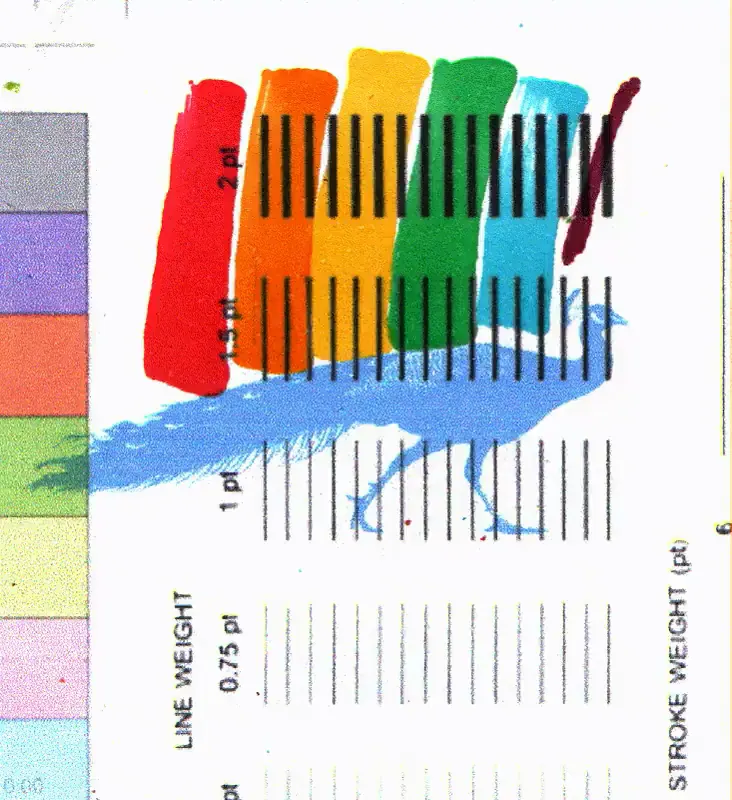
01, 0.00 to 0.08 seconds. Match the supplied opening frame. Large cropped pastel color squares form a vertical strip along the far left. Across the upper middle, thick rough vertical marker strokes in red, orange, yellow, green, cyan and narrow burgundy sit behind three groups of evenly spaced black vertical stroke weight bars. The blue bird crosses through the tests. Smaller fine bars continue in the lower half, with rotated LINE WEIGHT and STROKE WEIGHT (pt) labels and small point sizes. White paper remains visible between test groups.
02, 0.08 to 0.17 seconds. Use white paper with precise black vertical line tests at the upper left and black geometric printer samples at the right, including a filled diamond and hexagon with outlined counterparts, stars and a triangle. Thin printed labels such as SOLID SHAPES, OUTLINE SHAPES and TEXT SIZE (pt) run sideways. Add loose green, orange, cyan and red marker strokes and loops, with one broad mustard orange stroke near the lower right. The bird remains across the middle.
03, 0.17 to 0.25 seconds. Place three tall cyan, magenta and yellow bars toward the left, a black vertical bar beside them, fine black alignment line grids near the upper right, and smaller CMYK blocks at the bottom. Add large loose cyan pen loops at the upper right and below the bird. Keep the sideways FINE ALIGNMENT LINES and COLOR BARS labels as small technical print.
04, 0.25 to 0.33 seconds. Dense broad golden yellow marker covers much of the upper and middle sheet. Add scattered short red upright or diagonal strokes. Keep a column of large colored calibration rectangles cropped along the left and a grid of cyan, pink, yellow, green, blue and gray patches across the lower right, visible through and around the marker. The bird's long blue tail remains clearly visible over the print.
05, 0.33 to 0.42 seconds. Mostly white paper. Several very large loose cyan pen loops surround and overlap the bird, forming an uneven circular contour. Black filled and outlined circles and squares occupy the upper strip. Fine gray grid lines and a small radial line target remain behind the bird. Retain rotated technical labels along the lower left. No colored full page wash.
06, 0.42 to 0.50 seconds. Cyan, magenta, yellow and black vertical gradient bands occupy the left half, with a vertical set of small color squares below and beside the bird at right. A dense green marker rectangle sits in the upper right. The middle blue bird crosses the gradient tests. Preserve white spaces and fine printed labels such as CMYK GRADIENTS and SWATCHES in rotated orientation.
07, 0.50 to 0.58 seconds. Fill much of the center with a regular CMYK test patch grid, organized into short rows and columns in yellow, red, green, blue and dark gray. Keep the vertical CMYK COLOR PATCHES label near the left. Add three large loose orange oval loops, one above and two below the bird. The bird overlaps the grid with its blue ink becoming visually denser over dark patches.
08, 0.58 to 0.67 seconds. Return to a mostly white registration sheet. Several black circular crosshair targets and black halftone dot samples surround the bird, with REGISTRATION & ALIGNMENT printed vertically near the left side. A dense cyan ballpoint scribble cluster occupies the upper middle and right, and a large partial black circle touches the lower edge. No large colored background fill.
09, 0.67 to 0.75 seconds. Black technical labels, a vertical CMYK gradient region at upper left and a compact multicolor square patch chart at upper right. Add tangled red pen loops at the upper left, plus a broad red diagonal marker block in the lower left. Keep the bird crossing the center above that lower red block and preserve a large clear white region around its feet.
10, 0.75 to 0.83 seconds. A single thick magenta hand drawn ring dominates the page, enclosing most of the bird's body. Behind it are broad vertical cyan, magenta, yellow and black gradient bands with small C, M, Y, K marks near their base. A gray gradient strip crosses below. Preserve the ring's irregular thick edge and the sideways CMYK GRADIENT label. The ring is one already finished drawing, not an animated stroke.
11, 0.83 to 0.92 seconds. The busiest state. Fill the page with overlapping cyan zigzag pen waves, orange vertical loops, broad red marker strokes and green marks over a printer resolution and overprint sheet. Include a black halftone or check pattern in the upper right and a gray circular test patch near the left middle. The blue peacock remains recognizable across the central strip despite intentional overlapping print.
12, 0.92 to 1.00 seconds. Use tall precise cyan, magenta, yellow, gray and black gradient strips, with fine line samples at the left and small black technical gradient labels. Overlay short green horizontal strokes, a few red diagonals and a loose gray pen circle. Let some colored gradients cross the bird's body and long tail. Hard cut back to the opening stroke weight sheet without an extra hold.
Preserve matte white paper texture, grainy blue transfer pigment and small incidental printer imperfections. All motion comes from the bird's discrete walking poses, slight print registration jitter and abrupt replacement of the background drawing. Do not create cinematic camera motion, realistic feathers, a three dimensional bird, a fanned tail, floating swatches, moving text overlays, dissolves, smooth morphing, animated handwriting, added watermark, player controls, soundtrack or subtitles.
Prompt details and source
Ricostruito da tutti i dodici fotogrammi decodificati della fonte e dai tempi misurati. È una specifica video, non un prompt per una copertina fissa, e non è stata convalidata con una riproduzione generata.
Leggi il prompt del primo fotogramma
Create one finished portrait image in the near square ratio 732:800. It is a flat scan of a white printer calibration sheet covered with handmade colored marker strokes and a single powder blue peacock silhouette. The paper fills every edge, with no visible tabletop, page border or interface. The peacock faces right in strict side profile, its slender head and small crest near x = 81 percent and y = 38 percent, its body stretching horizontally across the center, and its long ragged closed tail streaming left beyond the left edge. Keep the two thin walking legs distinct in the lower middle. Do not open the tail into a fan. Use flat uneven blue printed pigment with grainy, fibrous edges, no realistic feather shading.
Across the upper middle, paint six broad uneven vertical marker swatches in red, orange, golden yellow, green, cyan and a narrow dark burgundy stroke. The strokes run roughly from y = 7 to 47 percent. They have rounded rough ends, overlapping translucent areas and visible hand pressure. Overlay rows of precise black vertical test bars, with three prominent groups at approximately y = 14 to 27, 34 to 47 and 54 to 67 percent. Each group contains many evenly spaced narrow bars. Vary the weight between groups instead of making one barcode block. Let the middle and lower tests cross the peacock's neck, body and legs.
Crop a vertical column of large pastel calibration squares along the far left edge, colored gray, lavender, coral, green, pale yellow, pink and cyan from top to bottom. In the lower half, continue fine black vertical line weight tests on white. Keep small print labels rotated 90 degrees, including LINE WEIGHT near the lower left and STROKE WEIGHT (pt) near the lower right, with the weights 2 pt, 1.5 pt, 1 pt and 0.75 pt beside the relevant test areas. These labels are part of the printer calibration artwork and should remain sideways, with a few fragments naturally cropped by the edges.
Use an almost white warm paper base, uniform scan light, modest analog print noise and small isolated ink marks. Preserve the difference between mechanical printed rules and rough translucent felt marker. The centered blue bird remains legible despite intentional overprinting. No title, decorative slogan, realistic bird, fanned tail, glossy paper, camera tilt, floating paper scraps, shadowed collage layers, contact sheet, watermark or playback controls. This prompt describes one still frame, not a video.
Un pavone blu cammina in un loop di collage di carta di dodici fotogrammi, con segni a mano e prove di stampa che cambiano. Ottieni il prompt video e il primo fotogramma da adattare in Clico Web.
Riferimento del primo fotogramma
 Scarica il primo fotogramma
Questo fotogramma verrà trasferito in Clico Web. Potrai sostituirlo lì.
Camera: Vista frontale fissa di un piano di carta. Nessuna panoramica, inclinazione, zoom o variazione prospettica della camera. L'animale cambia posa camminando sul posto mentre l'intero collage stampato cambia a ogni fotogramma.