Video prompt
Create a 9.6 second square monochrome typographic portrait animation using the supplied first frame as the exact opening. A human head and short neck are represented entirely by many fine horizontal lines of tiny white and gray text on a pure black background. Preserve the small typographic scale, the central placement and generous black margins. There is no solid skin, visible mesh, filled silhouette, separate eye texture or photographic face beneath the text.
CAMERA AND FORM
Fix the camera, focal length and framing. Keep the head centered, occupying roughly the central half of the width and around two thirds to three quarters of the height at its most visible. The subject turns around its own vertical axis; the camera does not orbit. Use a calm upright head with a defined forehead, nose, mouth, chin, ears and a short neck that ends without shoulders. Retain one consistent head shape throughout.
TEXT AS SURFACE
Arrange the microtype into closely spaced horizontal bands that wrap over the curved facial surface. Baselines bend around the forehead, cheeks, nose and neck, becoming compressed at the silhouette and broader on surfaces facing the viewer. Different bands may have small gaps and different brightness. Text lines are the sole description of the volume. They must travel with the turning head, with convincing surface occlusion, rather than slide as a flat overlay across a static face. Preserve the supplied text texture where visible; newly exposed surfaces should continue its visual density without introducing a large readable slogan.
TEMPORAL SEQUENCE
The opening is very dark, with only scattered portions of text around the face and neck visible. Through roughly the first two seconds, additional horizontal bands gradually reveal the head while the slow axial turn is already under way. The silhouette and facial contours become readable from the changing curved lines.
Across the middle of the shot, continue a smooth steady turn through successive three quarter and profile orientations. At the more frontal views, show the nose, brow, mouth and both sides of the head through the bending and spacing of the text bands. Toward each profile, compress the far side and let it disappear behind the near side. Keep the turning pace even and the head scale fixed, with no nodding, speech, eye animation or added expression.
During the last few seconds, progressively remove or darken many bands so the complete head gives way again to isolated fragments and arcs of type. End near the sparse dark state of the opening while allowing the axial movement to continue smoothly. The ending should feel like a recurring reveal cycle, not a camera fade across an otherwise frozen head.
RENDERING
Pure black field, delicate off white microtype, faint gray text on receding surfaces and no colored glow. Avoid thick wireframe contours and horizontal scan beams. Tiny variations in line density should retain an editorial and computational feel without noisy glitch cuts. Original quiet audio may be added only if required; do not imitate the source soundtrack.
Negative prompt: camera orbit, zoom, pan, rotating background, photoreal skin, solid white head, facial texture fill, shoulder bust, talking mouth, changing identity, large captions, thick wireframe, neon colors, extruded lettering, floating detached words, rapid spinning, frame jitter or interface elements.
Prompt details and source
Motion prompt reconstructed from the source clip. The opening frame is included. Generated reproduction and source soundtrack recreation have not been verified.
Read cover image prompt
Create a square monochrome typographic portrait against a perfectly black field. A narrow, nearly frontal human head and neck appear near the center, with the face angled slightly toward the right. The bust occupies roughly two thirds of the height and one third of the width, leaving broad black space around it. Construct the entire form from many fine horizontal lines of tiny warm white type. There is no solid skin, sculpted surface or visible hair texture beneath the letters.
Wrap each line around the implied forehead, cheek, jaw and throat as a subtle contour. Lines become shorter near the top of the head and curve outward at the base of the neck. Let some areas disappear completely into black, including broad gaps across the upper face, so only discontinuous strips of type suggest the features. The cheek and lower face are denser and brighter than the nearly lost crown. Maintain a recognizable continuous head silhouette without drawing an outline.
Use this original text as the repeated small lettering: “A word becomes a line. A line follows a surface. Between the marks, a face begins to appear.” Keep the type extremely fine and softly luminous, with no bright halo. A static graphic rendering, no motion blur, separate heading, caption, frame, colored lighting or interface.
Monochrome human head and neck formed from closely arranged lettering against black. Get the video prompt and first frame to adapt in Clico Web.
First frame reference
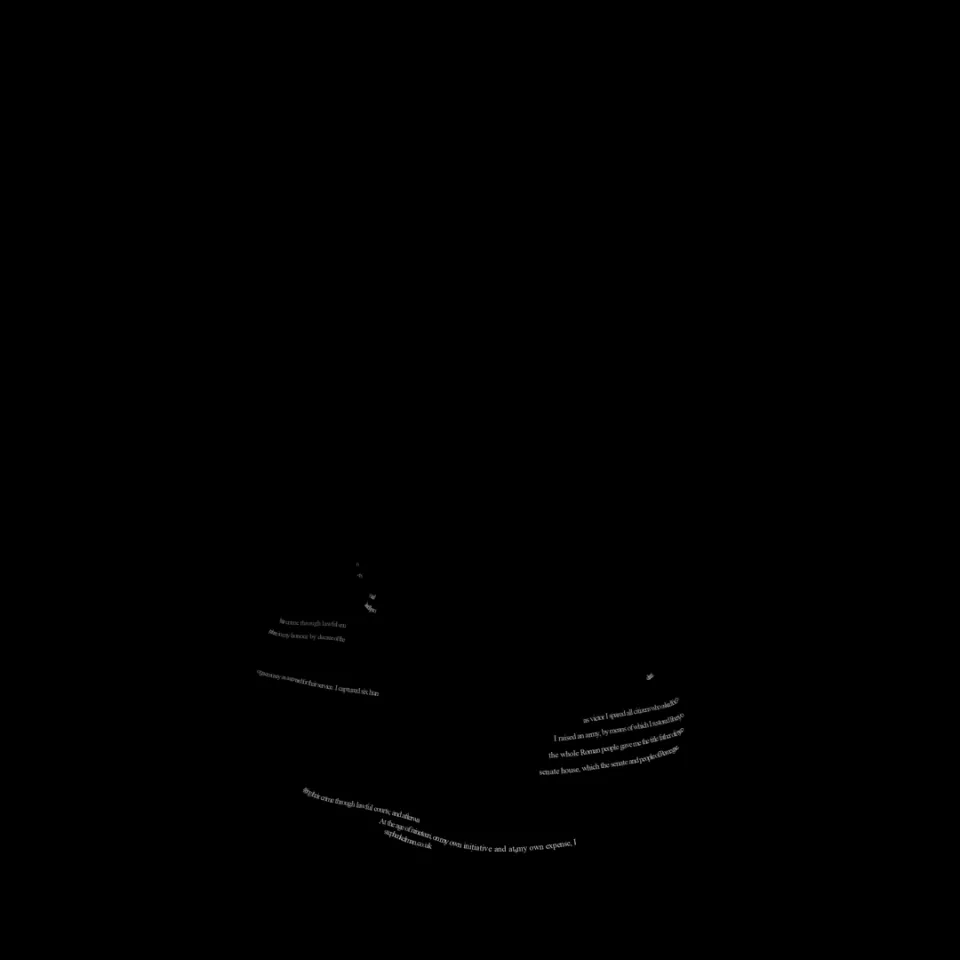 Download first frame
This frame is included when you continue to Clico Web. You can replace it there.
Camera: Locked camera. A typographic head turns on its own vertical axis while bands of white text appear and disappear across its surface.